How to Last Longer in Bed: Behavioral Techniques, Breathing and Kegel Training
Proven ways to last longer in bed: stop-start and squeeze methods, diaphragmatic breathing, edging, sensitivity tools, pacing tips and how Kegel exercises build lasting control.
Posted by
 Matt S.
Related reading
How to Do Kegel Exercises: Step-by-Step Routine and Muscle-Finding Guide
Learn what Kegel exercises are, how to find your pelvic floor muscles, a simple daily routine with sets and reps, progression tips and common mistakes to avoid.
Pelvic Floor Exerciser vs Kegel Exercises: Which Is Better?
Pelvic floor tools versus manual kegels: how they differ, pros and cons, which fits your goals and when apps like SQZ help with guidance and consistency.
Kegling Exercises Explained: Benefits and Proper Technique
What kegeling exercises do for men: benefits, how to find your pelvic floor, step-by-step technique, a simple daily routine and mistakes to avoid.
Lasting longer in bed is rarely about willpower alone. It comes down to how well you manage arousal, how calm your nervous system stays under pressure and whether you have trained the muscles that help you hold back at the right moment.
To last longer in bed, focus on mastering your breathing and arousal control. Use proven behavioral techniques, slow the pace of intercourse and utilize barrier methods like thicker condoms. Add pelvic floor training (Kegel exercises) and you cover both the mental and physical sides of stamina.
This guide breaks down the most effective methods so you can mix and match what fits your body and your relationship.
Understanding Your Arousal Scale
Many techniques below use a simple 1-10 arousal scale. A 1 is fully relaxed with little stimulation. A 10 is the point of no return where ejaculation is difficult to stop. Most control methods work best when you act around 7-8, before you cross into 9 or 10 territory.
Learning to read your own signals takes practice. Edging, mindful masturbation and guided pelvic floor work all help you recognize the early warning signs before it is too late.
Behavioral Techniques
These methods have been studied for decades and remain among the most reliable non-medical tools for premature ejaculation and general stamina.
The Stop-Start Method
When you feel the urge to climax (around a 7 or 8 on an arousal scale of 1 to 10), stop all stimulation entirely. Wait until your arousal level drops to a 5 or 6, then resume.
Repeat this cycle as needed during intercourse or solo practice. Over time your body learns that arousal does not have to end in immediate release. Communicate with your partner so pauses feel intentional, not abrupt.
The Squeeze Technique
When you feel close to ejaculation, apply gentle pressure just below the head of the penis for 10-20 seconds. This reduces arousal and allows you to continue.
Use firm but comfortable pressure with your thumb on the underside and fingers on top. Release fully before resuming stimulation. Pair this with the stop-start method if one alone is not enough.
Physical and Lifestyle Practices
Diaphragmatic Breathing
Deep belly breathing during sex calms your nervous system and prevents the sympathetic overdrive that triggers ejaculation. Shallow chest breathing often speeds up heart rate and tightens the pelvic area, which works against control.
Practice off the bed first: inhale so your belly expands, exhale slowly through your mouth. During sex, keep that rhythm even when intensity rises. Slow exhales are especially helpful right when you approach 7-8 on your arousal scale.
Edging
Practice mindful masturbation by pushing yourself to the brink of climax and stopping repeatedly. This conditions your body to recognize the point of no return and gives you room to back off before you cross it.
Start with 2-3 stop cycles per session and build from there. Stay present instead of rushing. The goal is awareness and control, not finishing as fast as possible.
Reduce Sensitivity
Consider using thicker condoms or topical delay sprays and wipes containing lidocaine or prilocaine. These can take the edge off sensation so behavioral techniques are easier to apply.
Test any topical product on a small area first and follow label directions. Some men use a thin condom over a delay wipe to protect their partner from numbing agents.
Vary the Pace and Positions
Slow down and let your partner take the lead or switch to positions that offer less intense, deeper thrusting. Missionary, side-by-side or partner-on-top variations often make it easier to pause, breathe and reset arousal than high-friction positions.
Changing rhythm before you hit 8 on the scale is easier than trying to recover after you are already at 9.
Kegel Exercises for Lasting Longer
Breathing and behavioral tricks work best when the pelvic floor muscles behind them are strong and responsive. That is where Kegel exercises come in. They train the same muscles that contract during ejaculation, so you can squeeze to delay release or relax to reduce tension that speeds it up.
For men, a stronger pelvic floor is linked to better ejaculatory control, improved awareness during sex and support for erection quality. Think of Kegels as the physical foundation that makes stop-start, the squeeze technique and edging more effective.
How Kegels help in the moment
- Hold-back squeeze: A deliberate pelvic floor contraction at 7-8 arousal can reduce urgency the same way the manual squeeze technique does, without always needing your hand.
- Relaxation control: Learning to release the pelvic floor prevents the chronic tightness that pairs with shallow breathing and fast climax.
- Faster recovery: After a stop-start pause, trained muscles help you settle back to a 5-6 arousal level more quickly.
Simple daily Kegel routine
Find your pelvic floor by imagining you are stopping urine midstream or holding back gas. You should feel an inward lift, not a thigh or ab crunch.
- Squeeze and hold for 3-5 seconds
- Relax fully for 3-5 seconds
- Repeat 10 times for one set
- Complete 3 sets spread across the day
As strength improves, work toward 10-second holds. Never practice Kegels while urinating and avoid overtraining, which can cause soreness or difficulty emptying your bladder.
Consistency matters more than intensity. Most men notice better awareness within a few weeks and clearer control within 6-12 weeks when Kegels are paired with the behavioral methods above.
Putting It All Together
A practical session might look like this:
- Train Kegels daily so your pelvic floor responds on demand.
- Use diaphragmatic breathing from the start of foreplay.
- Monitor arousal on a 1-10 scale and slow down before you reach 8.
- Apply stop-start or the squeeze technique when needed.
- Use a thicker condom or approved delay product if sensitivity is high.
- Vary pace and position so you stay in control instead of chasing friction.
No single trick works every time for every man. The men who see the best results stack breathing, behavioral skills and pelvic floor training instead of relying on one approach alone.
When to Talk to a Doctor
Occasional early ejaculation is common. See a clinician if the problem is persistent, causes distress or does not improve after several weeks of consistent practice. They can rule out hormonal, prostate or psychological factors and discuss prescription options if needed.
Staying Consistent With SQZ
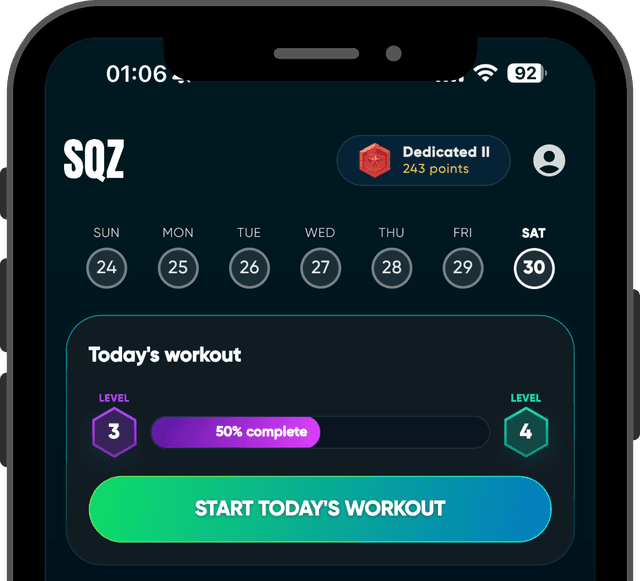
Behavioral methods and breathing only stick if you practice them regularly. SQZ helps you build the pelvic floor habit with timed Kegel sessions, progress tracking and reminders so your daily training matches what you need in the bedroom.
Combine app-guided Kegels with stop-start practice, edging and slow breathing and you cover the full picture: body, mind and arousal management.
Conclusion
Lasting longer in bed is a skill you can train. Master your breathing, use stop-start and squeeze techniques when arousal climbs, manage sensitivity with condoms or delay products when helpful and do not skip Kegel exercises for the muscular control that ties everything together.
Start with one or two methods, add the rest over time and measure progress in weeks, not days. Control is built through repetition, not luck.
Want structured Kegel training that fits your day?
Take a quick quiz to get a personalized Kegel plan in seconds.